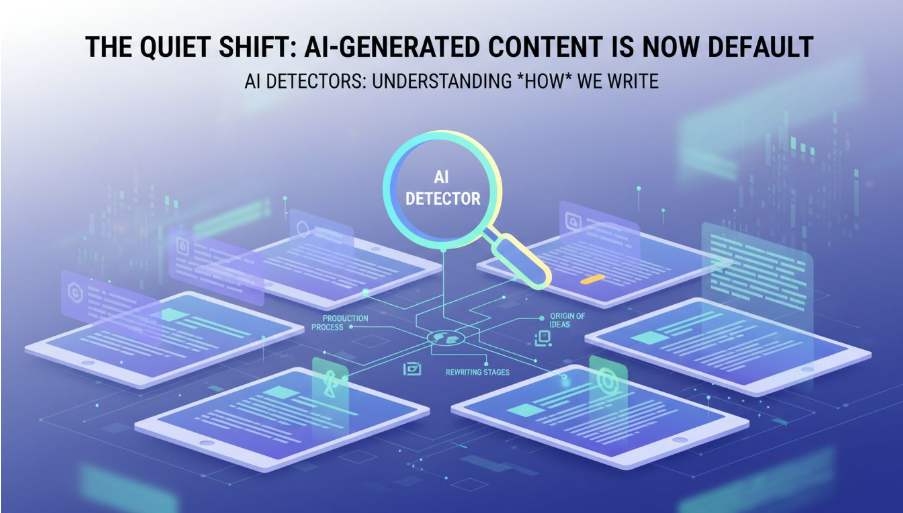
AI-generated content has quietly moved from “experimental” to “default.” Most blog posts, landing pages, and even academic drafts now pass through tools like ChatGPT, Claude, or Gemini at some stage. In this environment, an AI Detector is no longer just a verification tool—it’s becoming a way to understand how writing is actually produced, not just who wrote it.
But here’s the uncomfortable truth: the more natural AI writing becomes, the harder it is to trust your instincts alone. That’s exactly where tools like Dechecker sit—not as final judges, but as interpretive systems.
AI writing doesn’t look like AI anymore—and that changes the game
If you still expect AI-generated text to sound robotic, you’re already behind the curve. Modern models produce writing that feels polished, structured, and strangely “neutral” in a way that often passes as professional human writing.
Why AI Detector tools struggle with modern writing styles
The core challenge for any AI Detector is that it’s no longer comparing “good writing vs bad writing.” It’s comparing two types of good writing.
SEO articles, corporate blogs, and even student essays all tend to follow similar structural patterns: clear transitions, balanced paragraphs, predictable pacing. Ironically, that’s also how AI systems are trained to write.
So when an AI Detector flags content, it’s often reacting to structure, not quality. And that’s where misinterpretation happens.
The blurred line between human editing and AI output
Most real-world content today is not purely human or purely AI. It’s mixed.
A draft might start in ChatGPT, get rewritten by a human, then optimized again for SEO. At that point, even the author may not fully know what percentage is “AI.”
An AI Detector tries to quantify that blend, but it can only work with patterns—not intent.
That gap between intent and pattern is where most confusion comes from.
How Dechecker AI Detector actually interprets text behavior
Dechecker’s approach to detection is not about spotting obvious AI phrases. It focuses more on structural predictability and linguistic flow across entire passages.
Why predictability matters more than vocabulary
One common misconception is that AI Detector tools look for specific words or phrases. In reality, vocabulary matters far less than structure.
What matters is how predictable each sentence becomes in context. If every sentence follows a similar rhythm, with evenly distributed complexity, the text starts to resemble machine-generated output.
Human writing, even when professional, tends to break rhythm slightly. A short sentence here. A longer reflection there. That irregularity is surprisingly important.
AI Detector scoring is closer to “style measurement” than truth
An AI Detector score is not a statement of authorship. It’s closer to a style probability indicator.
High score doesn’t automatically mean AI wrote it. Low score doesn’t guarantee human authorship either.
It simply reflects how closely the writing aligns with known AI-like structures.
That distinction matters more than most users realize.
Where AI detection becomes practically useful (and where it doesn’t)
A lot of discussions around AI detection assume it has universal application. In reality, its usefulness is situational.
When writing feels too clean to be natural
Writers often reach a point where their content reads smoothly but feels emotionally flat. No friction, no variation, no “human noise.”
That’s usually when an AI Detector becomes useful—not to judge, but to diagnose structure.
If everything looks too uniform, the tool often confirms what intuition already suspects: the writing is over-optimized.
Using AI Humanizer to restore natural flow
Once content feels too mechanical, many workflows move it through an AI Humanizer.
An AI Humanizer adjusts sentence rhythm, softens structure, and introduces variation in phrasing so the text feels less predictable.
It doesn’t rewrite meaning—it reshapes delivery. That’s the key difference.
When paired with AI Detector feedback, it becomes part of a loop: detect, adjust, refine, repeat.
SEO content and the unintended AI similarity problem
SEO writing is where AI detection becomes tricky.
Because SEO rewards structure, clarity, and consistency—exactly the same traits AI models are optimized for.
So writers end up in a strange position: improve structure for SEO, but risk appearing too AI-like to an AI Detector.
There’s no perfect solution, only tradeoffs between readability, optimization, and perceived authenticity.
AI detection is shifting from judgment to interpretation
The role of AI Detector tools is slowly changing. They are no longer treated as strict classifiers but as interpretive layers in content workflows.
Editors now treat AI as a normal writing input
Most editorial teams don’t try to eliminate AI usage anymore. Instead, they define boundaries around how it should be used.
AI is fine for drafting. Sometimes fine for structuring. But final tone and nuance still need human adjustment.
In that workflow, an AI Detector acts more like a feedback tool than an enforcement system.
Writers increasingly test their own content
Interestingly, many writers now run their own drafts through AI detection tools before publishing.
Not because they are trying to “pass a test,” but because they want to understand how their writing feels structurally.
If something scores too high, it often signals over-structuring or loss of voice.
That self-check behavior is becoming more common than external enforcement.
The direction AI Detector tools are moving toward
AI detection is gradually becoming part of a larger ecosystem that includes writing assistance, rewriting tools, and content evaluation systems.
From detection tools to writing feedback systems
Instead of simply saying “this looks AI-generated,” future systems will likely explain why.
Too predictable sentence rhythm. Too uniform structure. Too consistent tone.
That kind of feedback is more useful than a single score.
Detection + rewriting will become a single workflow
In practice, many writers already use a loop:
draft → check with AI Detector → refine → humanize → finalize
This workflow is becoming standard in SEO and content marketing environments, even if it’s not formally documented.
Final thought on AI Detector relevance
An AI Detector is no longer about identifying “who wrote it.”
It’s about understanding how writing behaves—whether it feels too structured, too predictable, or too machine-like.
And in a world where AI writing is everywhere, that subtle distinction is becoming the only thing that still matters.